Across the genome, outside of a small -number of known imprinted genes and regions subject to X-inactivation in females, DNA methylation at CpG dinucleotides is often assumed to be complementary across both alleles in a diploid cell. However, recent findings suggest the reality is more complex, with the discovery that allele-specific methylation (ASM) is a common feature across the human genome.
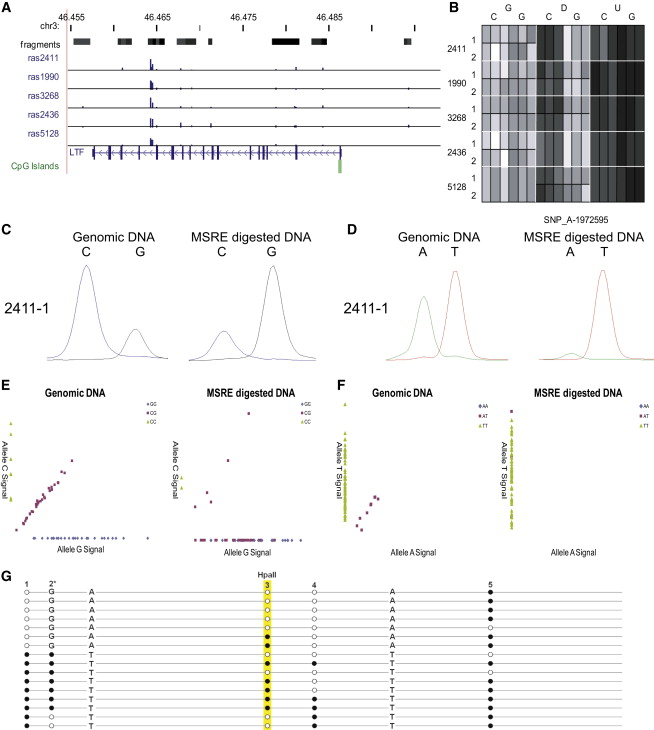
We have developed a method using SNP microarrays to quantitatively assess ASM in the human and mouse genome following cleavage with a cocktail of methylation-sensitive restriction enzymes (MSREs), and are now adapting this method for use in conjunction with ultra-deep sequencing.
A key observation is that the majority of ASM is associated with genetic variation in cis, although a noticeable proportion is also non-cis in nature and mediated, for example, by parental origin. We also see some evidence for differences in ASM at specific loci between genetically identical MZ twins (who also share the parental origin of alleles), indicating that stochastic and/or environmental factors may be important.
ASM appears to be both quantitative, characterized by subtle skewing of DNA methylation between alleles, and heterogeneous, varying across tissues and between individuals. These findings have important implications for complex disease genetics; while cis-mediated ASM provides a functional consequence for non-coding genetic variation, heterogeneous and quantitative ASM complicates the identification of disease-associated loci. We propose that non-cis ASM could contribute toward the "missing heritability" of complex diseases, rendering certain loci hemizygous and masking the direct association between genotype and phenotype. Our data suggest that the interpretation of results from genome-wide association studies can be improved by the incorporation of epi-allelic information and that in order to fully understand the extent and consequence of ASM in the human genome, a comprehensive sequencing-based analysis of allelic methylation patterns across tissues and individuals is required.
Please click HERE to browse our genome-wide ASM data.